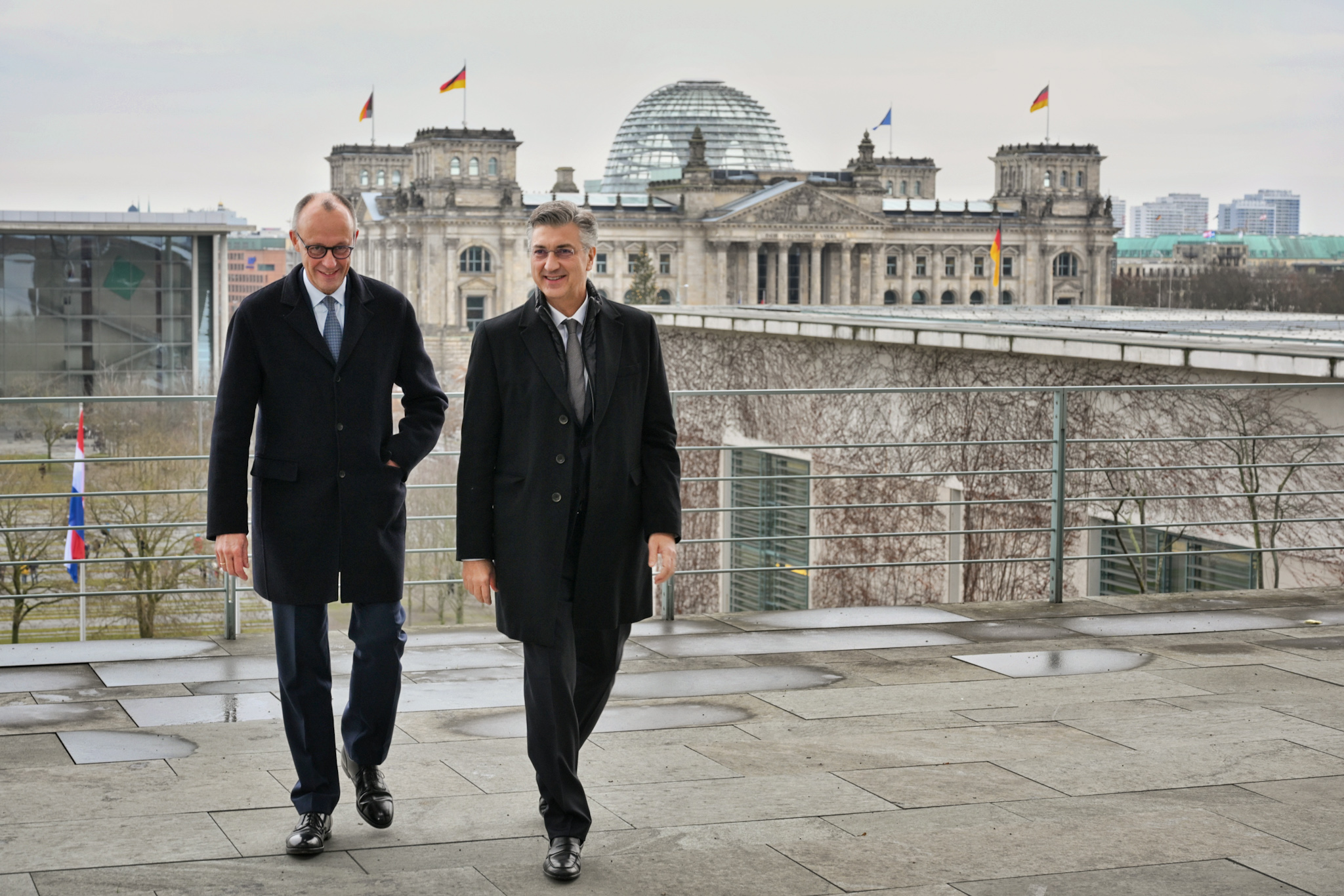
Prime Minister Andrej Plenković met today in Berlin with the Federal Chancellor of Germany, Friedrich Merz, with whom he discussed bilateral relations, strengthening economic cooperation and the procurement of 44 Leopard tanks, the most modern tanks available on the market. They also discussed key topics for the future of the European Union in view of the meeting of the European Council, finding a solution for further financial support to Ukraine, as well as international efforts to achieve a lasting and just peace in that country.
After the meeting, Deputy Prime Minister and Minister of Defense Ivan Anušić signed an agreed document - an order confirmation authorizing the Federal Ministry of Defense of the Federal Republic of Germany to conclude, on behalf of the Ministry of Defense of the Republic of Croatia, an amendment to the contract No. Q/K2BB/R8784 with the company KNDS Deutschland GmbH & Co. KG on the delivery of Leopard 2A8 tanks to Croatia.
Merz: We are consciously deepening our relations
In a statement to the media, German Chancellor Merz spoke about the connection between the two countries and said that more than 400,000 Croatians live in Germany, and that millions of Germans visit Croatia.
He emphasized that the two countries are consciously deepening their relations.
Speaking about the signed agreement on the purchase of Leopard 2A8 tanks, he said that we are strengthening our armed forces as allies in NATO and connecting them through these systems even more efficiently and without obstacles. This has never been more important than today, he added.
"The goal of this and similar projects must be the standardization and simplification of weapons systems within the European Union in order to enable maximum production of the systems", Merz said.
"We both agree that Europe is currently facing challenges like never before," said Merz, adding that this is not only about Russian aggression against Ukraine, but also about hybrid threats to Europe, among other things, said Chancellor Merz.
Regarding the situation in Ukraine, Chancellor Merz recalled the current diplomatic dynamics in order to achieve lasting peace as soon as possible, emphasizing that only Kiev can decide which territorial arrangement it can accept.
"Ukraine needs strong security guarantees from its partners, the US and NATO, and everything that concerns us Europeans requires our consent," said Merz.
Plenković: We appreciate Germany's support throughout all phases of our international positioning
Prime Minister Andrej Plenković thanked Germany for taking care of the interests of smaller countries as the largest member of the European Union.
"Croatia greatly appreciates Germany's support from the moment of our international recognition through all phases of our international positioning, which were accompanied by continuously strengthened relations between the two countries," he said.
He emphasized that Germany is Croatia's first foreign trade partner, adding that annual trade last year reached 9 billion euros, and more than 3.2 million Germans visited our country in 2024.
He particularly emphasized the contribution of the Croatian community living in Germany, almost half a million of them, to strengthening overall relations between the two countries.
Speaking about the signed agreement on the procurement of 44 Leopard tanks, with the aim of modernizing and strengthening Croatia's defense capabilities, the Prime Minister emphasized that this is an important part of the mosaic of gradually abandoning Eastern military technology and switching to Western ones.
In addition, he said, it is about further strengthening the partnership between Croatia and Germany in the field of defense and security.
He expressed satisfaction that part of this visit is also a large German-Croatian economic forum, which will give new impetus to business relations between the two countries.
Continued financing of Ukraine and the new EU financial framework
When it comes to efforts to achieve a lasting and just peace for Ukraine, the Prime Minister said that Chancellor Merz informed him about the talks in the format of Great Britain, France and Germany with President Zelensky and representatives of the US administration.
In this context, he said that an extremely important topic at the European Council meeting next week will be an agreement on financing Ukraine's needs and direct assistance to the country's economic and financial bloodstream, as well as further investments in its defense capabilities.
They also discussed the new Multiannual Financial Framework, and the Prime Minister informed Chancellor Merz about Croatia's position as the youngest member of the European Union that is still in a position to catch up with countries that have been in the Union for a long time.
"We want the next financial framework to enable us to invest in precisely those areas that will allow Croatia to gradually play on the same field with equal economic strength as the members of the European Union that have been in the organization much longer than we have," he emphasized.
Recalling Germany's strong support at a time when Croatia was becoming a member of the eurozone and the Schengen area, the Prime Minister also thanked for the support for our upcoming membership in the OECD, a process that is entering its final stages.
Supporting neighbors in Southeast Europe on their European path
They also discussed the further expansion of the European Union to the countries of Southeast Europe, and Prime Minister Plenković said that Croatia's principled position is to support the efforts of all its neighboring countries, based on meeting the criteria and each according to its own merits.
He added that he particularly drew attention to Bosnia and Herzegovina, in order to enable it to join other countries that have already advanced in the accession process, and to resolve the issues of full equality of all three constituent peoples within the framework of this faster and more dynamic process, especially in the context of the upcoming 30th anniversary of the Dayton Agreement.
"In addition, the equality and position of the Croatian people, as the smallest constituent people, is extremely important to Croatia, which would also require a modification of the electoral law," said Plenković.
He added that this is an issue on which there is a broad consensus on the Croatian political scene and which is also often articulated by Croats in Bosnia and Herzegovina.
Prime Minister Plenković also informed Chancellor Merz about the overall economic situation in Croatia, emphasizing that the country has progressed over the past ten years and has continuous economic growth, among the fastest in the European Union, with an investment credit rating at level A.
Expanding cooperation in the defense sector
Answering journalists' questions about further cooperation in the defense sector, Prime Minister Merz emphasized that the Leopard agreement is more than just military cooperation, thanking the Croatian government for deciding on this purchase.
"We must cooperate more strongly in the European Union, including in harmonizing our systems," he said.
Prime Minister Plenković recalled that this purchase of Leopards began with an arrangement between Croatia, Germany and Ukraine, according to which Croatia ceded to Germany, and Germany to Ukraine the M-84 and M-80 tanks, which served it in defense against Russian aggression, and Germany compensated Croatia financially.
They also discussed, he added, the possibilities of cooperation between defense industries, in which he particularly highlighted the partnership between DOK-ING and Rheinmetall.
He also mentioned the Croatian company Orqa, which is one of the leaders in the production of FPV drones without Chinese components.
When asked by reporters how Croatia would decide on freezing Russian funds, the Croatian Prime Minister said that when making a decision, the legal certainty and reliability of the European Union as a financial partner should be taken into account.
"What we want is for all the moves we will make together to be legally sustainable," said Plenković.
Croatia offers alternative oil supply to Hungary and Slovakia
When asked about Russian energy products that continue to arrive in some European Union countries, or about the extension of the exemption from sanctions, Chancellor Merz said that Prime Minister Plenković explained to him in detail how sanctions against a company can affect the energy supply of a European Union member state.
"I got the impression that there are alternatives for those who buy oil and gas from Russia that we should consider in the European Union and I understood the technical context that exists in the region even better," he emphasized.
Prime Minister Plenković added that he explained to the German Chancellor in detail the full ability of the Adriatic Pipeline (JANAF) to deliver all the necessary oil to Hungary and Slovakia, at 100 percent capacity.
"There is therefore no real need for any exception for the use of non-Russian oil that would come to Hungary and Slovakia through Croatia," he emphasized.
As for Serbia, he added, Croatia is in a certain way in an absurd situation that, due to American sanctions, it is unable to transport non-Russian oil to the refinery in Pančevo due to the majority Russian ownership of NIS.
As a result, both JANAF and Serbia suffer financially, considering that 95 percent of the crude oil came via Croatia.
At the same time, the Hungarians convert the Russian oil that comes to Hungary via Druzhba into gasoline and diesel in their refineries and send it to Serbia in tankers.
"This is by no means the meaning of what the sanctions regime should be, given the existing circumstances," said Plenković.
Asked about the reform of the electoral legislation in Bosnia and Herzegovina, Chancellor Merz said that everything should be done so that the fundamental principles of the Dayton Agreement are not called into question.
News