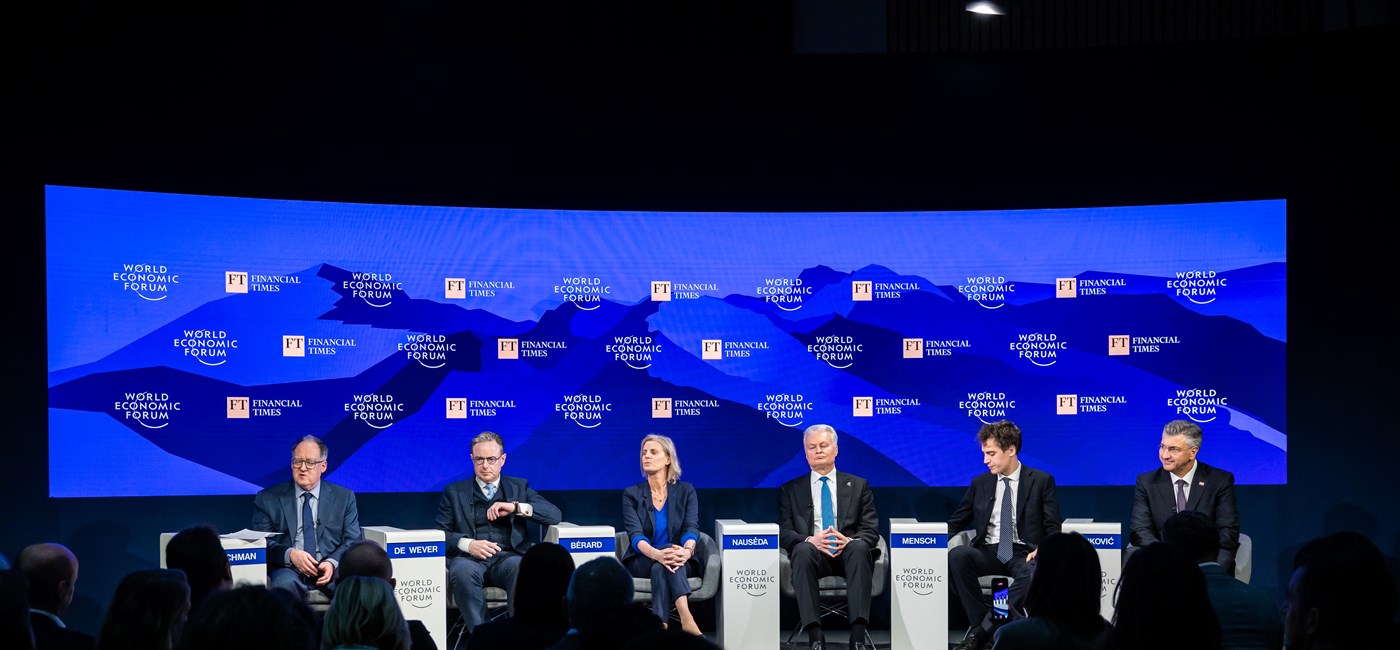
In addition to Prime Minister Plenković, the panel was attended by the President of Lithuania Gitanas Nausėda, the Prime Minister of Belgium Bart De Wever, the founder and CEO of Mistral AI Arthur Mensch, and the CEO of ABN AMRO Bank Marguerite Bérard.
The Prime Minister began his intervention by reviewing the conclusions of the European Council meeting held in December, regarding financial support for Ukraine, expressing satisfaction that a way had been found to continue this support for the next two years, both for defense financing and for the overall functioning of the country.
Regarding Russia's continued pressure, Prime Minister Plenković considers it crucial to continue strong support for Ukraine and thus support the side of freedom, democracy and international law.
"This is what we stand for and this is why we have supported Ukraine so strongly for the past four years," he said, adding that many will travel to Kiev on February 24, on the 4th anniversary of the aggression, in order to express continued support for the country in this way.
The European Union must be as united as possible to remain an important factor
Prime Minister Plenković believes it is necessary to bring the discussion on the peace treaty, which has now been put on the back burner due to Greenland, back into focus. However, these are the realities of a changing global order, he added.
As we have recently seen, he continued, global governance, international organizations and the international order, as we knew it are changing very quickly and everyone must adapt to this.
"The only sure way for the European Union to remain an important factor is to try to be as united as possible," he said.
Warning that not all governments necessarily sing the same tune, he added that if this were visible to those who would like as much division in the European Union as possible, this would be exactly the weak point they are looking for.
Therefore, the European Council meeting called for Thursday should show the support of the members to Denmark, while at the same time maintaining sensible, reasonable and good transatlantic relations with the United States.
Despite all the noise in the communication channel, Prime Minister Plenković stressed, the United States is an ally and friend of Europe and no one among the 27 members of the European Union has changed that position.
“We need to talk more and find solutions for the global order,” he stressed.
Possible geopolitical approach to further enlargement of the European Union
He also addressed the issue of further enlargement of the European Union, emphasizing that Croatia's position has always been in favor of enlargement, but also drawing attention to the need for a serious and open discussion and a fresh look at the coming years.
Croatia is the last member to join the European Union, he said, and that was 13 years ago, since when there has been no further enlargement. In addition, Croatia joined NATO in 2009, which at that time was an important message of stability and ensuring peace. That is precisely why Croatia's position is that it is important to maintain transatlantic relations.
He believes that we have reached a point where it is possible that the approach to enlargement will change. So far, this approach has been to meet all criteria and evaluate each country based on its own merits.
Now, this approach may change to a geopolitical approach to enlargement, especially if part of the peace agreement is a faster path for Ukraine towards membership in the European Union, he explained.
Such an approach, he added, would open the way to membership for our neighbors, the countries of Southeast Europe, and for Croatia it is strategically important that these countries, especially Bosnia and Herzegovina, seize this opportunity.
Regarding Ukrainian membership in the European Union, Plenković stressed that it has a lot to offer Europe in terms of security and defense, especially given its experience in war and defense.
Decision-making and the strength of the European budget
This debate, he stressed, will also depend on the absorption capacity of the European Union, which is rarely discussed but is equally important.
He explained that there are two key elements, the first is the decision-making process in a Union that would have more than 27 members, and the second is the budgetary implications that will then have an impact on all members. He added that this element should also be taken into account in the negotiations on the new Multiannual Financial Framework.
"This is a global moment in which the European Union needs to be stronger, when it comes to industry, and competitiveness, and the development of artificial intelligence, and especially defense and security, and in this context, enlargement should not be neglected," he said.
Russia wants to rehabilitate its position on the international scene
Regarding the sanctions regime, Prime Minister Plenković believes that everyone should be clear about what the Kremlin is doing.
Namely, he explained, the dialogue between the United States and Russia on Ukraine is a way to, for a start, re-establish relations between Washington and Moscow.
Second, he added, Russia wants to be in a position to gradually get rid of various sanctions regimes, and the third is full rehabilitation on the international scene.
"These are three steps that are crystal clear according to everything that has been happening in the last few months in the context of negotiations," believes Prime Minister Plenković.
He pointed out that, despite all the sanctions packages that have had an impact on the Russian economy, there has been no reflection on the political line or the political context, nor on the strengthening of the opposition, nor on the weakening of the regime, nor on a change of direction.
PRIME MINISTER PLENKOVIĆ IN DAVOS
By continuing our strong support for Ukraine, we stand on the side of freedom, democracy and international law
Prime Minister Andrej Plenković is participating in Davos at the World Economic Forum Annual Meeting, which began with a panel on the topic "Redefining Europe's Place in the World".
- 20.01.2026.
- video
-
photo
- Download photo
Gallery


.jpg?preset=news-carousel-img)