He began his speech by stating that the global international order is changing so rapidly and crises are coming one after another so quickly that everything has become unpredictable, with an incredible amount of political voluntarism, contrary to all customs, international law and traditional global governance.
Therefore, it is good, he added, that in today's discussion we put Croatian positions, values and interests in correlation with the world that is changing in a way that few expected.
"That is why the policy of modern sovereignty that we have been implementing for the past ten years is gaining even more meaning," he said.
Speaking about the current situation in the world, Prime Minister Plenković highlighted the Russian aggression against Ukraine, which is entering its fifth year, the attempted peace negotiations, the major fragmentation of global trade and finance, the strengthening of geo-economics as a means of political influence, the strengthening of tensions outside Europe, conflicts in the Middle East, tensions in the Indo-Pacific, global trade wars, energy policy and supply routes that affect all key decisions on the international scene, and the significantly different policy of the United States when it comes to multilateralism.
European Union's strategic autonomy
The European Council has addressed all these issues, he said, emphasizing that the European Union remains the largest trading bloc.
According to IMF estimates, the European Union generates around 13.8% of global GDP, comparable to the United States, which accounts for around 14.5%, while China accounts for around 19.8%.
"This shows that the European Union remains an important actor on a global scale and the largest common market with enormous regulatory power and perhaps underutilized leverage in some segments," he stressed.
That is precisely why, he added, the concept of strategic autonomy is gaining increasing importance.
Prime Minister Plenković said that negotiations on the Multiannual Financial Framework for the period 2028-2034 have begun.
Security and Defense
At the same time, security and defense have become the number one topic, with new instruments, financial resources and obligations, he said, recalling the agreement from the NATO summit in The Hague to allocate 3.5 percent of GDP for defense and 1.5 percent for defense-related activities by 2035.
In this context, he pointed out that in the budget year 2025, Croatia reached 2.08 percent of GDP in defense allocations, amounting to one billion and 931 million euros. Of this, as much as 34 percent was invested in modernization.
The Prime Minister informed that today we received information that the procedures for the requests we sent to the European Commission for the SAFE Instrument, where we have 1.7 billion euros of loans at our disposal, will be completed in the next few months and these funds will be available to us to increase defense investments.
Europe’s competitiveness
The European Council also spoke a lot about the competitiveness and resilience of the European economy, and a real discussion on this topic will be held at an informal meeting in Belgium in early February, following the weaknesses and structural challenges identified in their reports by Enrico Letta and Mario Draghi, and through the Competitiveness Compass, an instrument prepared to help diversify supply chains, ensure reliable access to critical raw materials, strengthen energy independence, accelerate the decarbonization of key industrial sectors and invest more heavily in the development of critical technologies.
All this is happening at a time of demanding circumstances of the sanction’s regime for energy security, which also had repercussions on Croatia, said the Prime Minister, especially the exceptions provided in that regime for Hungary, which had the possibility of supplying cheap Russian gas and oil, and Serbia, which fell under the US sanctions regime, which prevented transport via the JANAF oil pipeline to the refinery in Pančevo.
The situation here is changing now, he said, and in this context, it enables better business and the income of our company.
New European budget
Regarding the new Multiannual Financial Framework, the Prime Minister said that preliminary negotiations have started well, recalling that a three-pillar structure was presented - national, regional and partnership plans, the European Competitiveness Fund and Global Europe.
On this occasion, he also rejected misinformation that appeared in some media that European funds would dry up.
"I want to reiterate to the Croatian public that this is the largest budget that the Commission has proposed to the member states in the history of the European Union," he stressed, adding that it comes as a new framework for new times, new priorities and new challenges facing Europe.
At the moment, estimates of the national Croatian envelope are around 19 billion euros, which is more than in the previous budget.
There is no Next Generation EU Instrument in the new budget, he added, because at the moment there is no such challenge as the Covid-19 pandemic to which this instrument was a response.
The preliminary discussion suggested that most member states are satisfied with the existing new structure, with certain modifications that will be insisted on.
Countries like Croatia, which are still budget users to a greater extent, that is, the so-called Friends of Cohesion Policy, want the funds that will be reserved specifically for them to be such that they can implement a policy of catching up.
There are also additional funds through other funds, and the biggest challenge will be how to use European funds that are available to everyone, horizontally, said the Prime Minister.
Financial support for Ukraine
Ukraine was, without any doubt, the most important topic of the European Council in December, said the Prime Minister, recalling that the member states were trying to solve the problem of continuing to finance not only defense, but also the functioning of the country in the next two years.
He recalled that the approach had three scenarios. One was to use frozen Russian assets, which are mostly located in Belgium. The second was a loan on the capital market, and the third was direct national contributions.
The variant with direct national contributions was immediately abandoned as an option, and very detailed discussions were held in which the loan option prevailed, also due to the legal certainty of avoiding all possible risks for the member states.
This loan amounts to 90 billion euros and will be used to finance both defense and the general functioning of the state, in the ratio of 60 billion euros for military assistance and 30 billion euros for civilian components.
The European Union will use the implementation of this loan through the Instrument for Enhanced Cooperation, in which not all member states participate, that is, in which Hungary, Slovakia and the Czech Republic do not participate, the Prime Minister explained.
He added that discussions are currently underway on the technical details of approving, using and repaying the loan, based on a proposal from the European Commission.
The guarantees and costs of the loan will be provided through the European budget - first through the budget's room for maneuver until the end of 2027, and then through regular contributions from member states to the budget, he said.
He stressed that the European Union will borrow on capital markets at significantly more favorable terms, which significantly reduces the total cost of financing.
"At the time of approving the loan, there is no direct financial obligation for member states, because the guarantees are provided by the Union itself through the European budget," he pointed out.
Ukraine should start repaying the loan only after Russia pays it war reparations - the deadline has not been defined at this time, because it depends on terms and maturity of the loan and the progress of peace negotiations, he added.
If Russia does not pay the compensation, Prime Minister Plenković explained, the obligations will be met from the European budget, in the next multiannual financial framework (2035-2041), and very likely in the period (2042-2048).
The cost of this arrangement will ultimately be borne by the member states participating in enhanced cooperation, through contributions to the European budget - with specific modalities still being discussed, he added.
“Such an arrangement has no impact on Croatia’s public debt or deficit, is based on the principle of European solidarity, and provides Ukraine with necessary and stable financial support in a crucial period,” he said.
The military aspect of aid to Ukraine
Regarding the military aspects of aid to Ukraine, Prime Minister Plenković stressed that Russian attacks on civilian targets continue with the aim of intimidating the population.
These attacks do not prove strength but essentially expose weakness, he assessed.
The so-called "three-day special operation" has turned into one of the greatest strategic and military failures of recent times, although Russia allocates as much as 40% of its state budget for defense, or about 9% of national GDP, he pointed out.
After at one point in 2022, he recalled, Russia occupied as much as 27% of Ukrainian territory, today it controls about 19%, only slightly more than at the end of 2022.
According to estimates from a number of international and security sources, Russian losses in this war are already huge and number in the hundreds of thousands, with a significantly higher number of wounded, the Prime Minister said.
The scale of these losses, in a war that lasts incomparably shorter, far exceeds the total Soviet losses in the ten-year war in Afghanistan and the American losses in the twenty-year war in Vietnam, he stated.
"Despite this, in the past year, the total area of Ukrainian territory that Russian forces have managed to occupy is smaller than, for example, Sisak-Moslavina County, that is 4,000 km² - about 0.6% of Ukrainian territory. Faced with failure on the battlefield, Russia is waging a war against civilians - by destroying energy infrastructure and terrorizing the population: these days Kiev is without electricity, and temperatures are dropping to -13 degrees. This has nothing to do with war. This is terrorism," he pointed out.
He added that a state of emergency has been declared in Ukraine because of this, but Ukraine is not surrendering - just as Croatia did not surrender in 1991.
All of this speaks of the cost and senselessness of Russian aggression, but even more of the strength, determination and endurance of the Ukrainian people.
"That is why I would like to pay tribute to them here once again for their courage and for the fight for freedom that is not only for Ukraine, but also for the values shared by the whole of Europe," the Prime Minister said.
Activities of the Coalition of the willing
He also referred to the support for Ukraine through the Coalition of the willing, especially the meeting in Paris, which was an opportunity to discuss in more detail the initiatives of the US administration to reach a peace agreement, but also the activities of the Coalition and individual actors in general.
Stressing that at this moment, decisions are not only being made about the end of the Russian aggression against Ukraine, but also about the future security architecture of Europe, the Prime Minister said that the Russian goal is to impose a solution under force and on its own terms, and before a ceasefire.
The American goal is to mediate in the earliest possible end to the war with which President Trump is not personally identified. From his position, these are two wars for which he holds both Russia and the weaknesses of his two predecessors, Obama and Biden, responsible. His goal is to achieve peace, because he sees himself as a peace president, he added.
The European goal or the goal of the large European countries and countries within the Coalition of the willing, which understand that this is a war on European territory where they must play an important role, is to help stabilize the situation, but after a ceasefire.
Some countries are ready to send soldiers to Ukraine, after peace is secured and monitoring of the ceasefire and demilitarized zone is carried out.
Due to President Milanović's decision, he reminded, the Croatian Army unfortunately does not participate in the military segment of the meetings of the Coalition of the willing.
In this way, Croatia is denied insight into the discussions on the preparations of all military activities undertaken by the Coalition of the willing, explained Prime Minister Plenković.
For example, he added, the Croatian Army was deprived of information that is available to Japanese, New Zealand or Montenegrin military representatives.
He assessed this as a big mistake, emphasizing that there is a large part of the countries that are part of the Coalition of the willing, and which, as the Croatian Government did during the EUMAM and NSATU, said in advance that their soldiers would not go to Ukrainian territory. However, their representatives are participating in these talks and are fully engaged in ensuring security at sea, in the air and on land.
However, Croatia is participating at the political level and will continue to do so, he emphasized.
The entire negotiation process is taking place very quickly, he explained, adding that there will be one large document of 20 points that will be a framework agreement, and five documents on individual sectors that will create the preconditions for peace, renewal, revitalization and reconstruction of Ukraine in the future.
Croatia's position is that we will assist Ukraine both politically and diplomatically and with our experiences, especially the peaceful reintegration of the Croatian Danube region, said the Prime Minister, recalling that the Government adopted the 15th military aid package a few days ago.
We also participate in the NATO PURL Initiative (Prioritised Ukraine Requirements List).
"Our foreign policy must not be isolationist, we must not close ourselves off, but we need to talk to our partners, monitor the activities of the international community, the European Union and NATO and our key partners and participate in them in a smart and solidary way that allows us to know what is happening," said Prime Minister Plenković.
He added that those who are not at the table know little, and those who are under the table should be ashamed, responding to those who want Croatia to conduct politics under the table.
"The Croatian Government is not in favor of such a policy and Croatia has something to say, show and contribute, and that is what we do in all our international contacts," he emphasized.
Enlargement of the European Union
In December, a regular summit meeting between the European Union and the countries of South-Eastern Europe was held, and EU is discussing how to approach the enlargement in the years ahead, said the Prime Minister.
This means, he explained, deciding whether a faster path to Ukraine's membership should be made possible through a geopolitical approach.
If this happens, then the optics of individual merits will be changed in our neighborhood as well, that is, it could happen that a geopolitical approach towards expansion is taken.
"We will be ready for all these scenarios and strongly and qualitatively, as before, articulate the protection of national interests", the Prime Minister concluded his speech.
EUROPEAN POLITICS
In the time of global changes and crises, our policy of modern sovereignty gains even more meaning
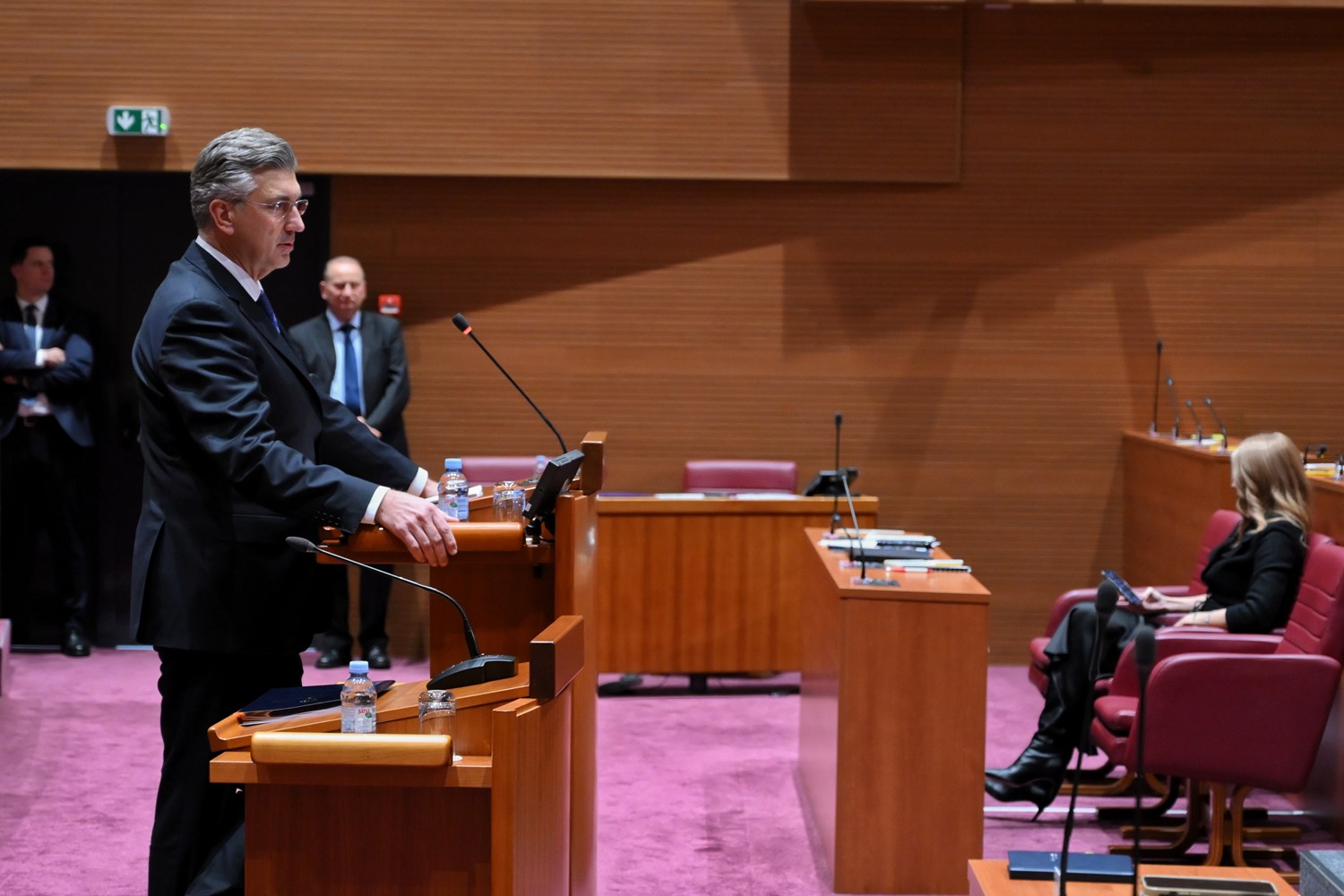
Prime Minister Andrej Plenković presented today in the Croatian Parliament the Report on the European Council meeting held on 18 December 2025 and on the summit of the European Union and the countries of South-Eastern Europe.
- 15.01.2026.
- video
-
photo
- Download photo
.JPG?preset=article-main-img)
Gallery


.jpg?preset=news-carousel-img)